21 January 2015

How to Cook a Wolf - Part one

Dear Colleague,

I recently starting reading How to Cook a Wolf  by MFK Fisher and have decided that over the next

Three little pigs - 
the wolf lands in the cooking pot - 
Project Gutenberg eText 
few weeks I will make an adventure of her wise words and recipes and share them with you.

For those not familiar with Fisher, she was born in 1908 in Albion, Michigan as Mary Frances Kennedy. Her family would move to California around 1911, her father deciding he wanted to own an orchard farm. The family would move up and down the California coast for several years until her father put himself back into the newspaper business. There Mary Frances begin a short writing career. She tried college off and on and finally married Alfred Fisher in 1929. From there her life was a whirl wind of marriages (three in all), movement (France, CA, NYC, Holland, etc.), children (two daughters) and writing. She would write off and on for years producing a collage of books and essays. She passed away in 1992 in Glen Ellen, CA.

How to Cook a Wolf was written in 1942 (and revised in 1954) when war time shortages were the norm. The overall concept: How to cook with what you have and how to make it good and simple. Her writing style is bold, arrogant and sassy.   [Note: I am reading the revised version that was published in 1988 by North Point Press. The 1942 version was published by World Publishing.]

She sets out in the first chapter (How to be Sage Without Hemlock) to disassemble the theory of a balanced diet. What one person may need (three meals a day) may not work for another. She goes on to destroy the theory first by sitting into place that this is indeed an idea created by the food industry, to whip women into a tizzy that they need to spend their days worrying over the “Three Meals a Day”. She argues this “idea” is hard on the family to maintain not only on the “wills” but on the pocket book. (p. 6)

Her way of thinking: “We should be using our minds as well as our hearts in order to survive….to live gracefully if we live at all.” (p. 6-7)

Her simple plan: Balance the day, not each meal in the day. (p. 7) Of course she says change is never easy and those that are used to their pudding every day may not go willingly into this concept. But if the food is good and tasty, then they will change over time.

Her beliefs: balance, keeping it simple, keeping it fun, eat how you feel, eat what is fresh, in season, available and make something good from it. It doesn't take much.

Less is key, extravagance is for the weak. And these words were written seventy years ago, how true to today with our over indulgence of food!

She believes if you eat the way you want to, which is simple, that you will awaken new pleasures and remember old ones (p. 9)

The second chapter titled How to Catch the Wolf (aren't these wonderful titles!) talks about how war time easily applies to today. You don’t need fancy or processed to make a good meal. A favorite line: “A three minute egg still takes about as long today as it did in 1722.” She is referring to all the new pots and pans that have come out to make your cooking “better.” (p. 13)

She tells you, it is your responsibility to weed through all the things presented to you, to truly find what you truly need.

In her chapter How to Distribute your Virtue, she gives practical ideas for making things go longer, not using as much energy – putting crackers in eggs, using a pressure cooker, even a haybox! Ways to store foods in the fridge (never put meats in plastic, wash fruits and vegetables, reusing your cooking fat). Cook for two meals versus one to save energy.

Thoughtfulness – doing these simple things, never wasting is something we must do in peace and war time “if we may continue to eat to live.” (p. 20)

Her writing at times can almost seem condescending, but you cannot help but laugh at her ability to make you feel smart and yet stupid all at the same time. Her arrogance and candor are charming.
I love how she takes food and makes it sound so simple and so delicious. She doesn't describe things with a lot of adjectives. She states it plainly for what it is. A piece of toast spread with butter and a simple jam and served with a cup of coffee. That sounds like the most amazing meal you would ever eat, yet there is nothing to it. How wonderful, to be that simple.

If you were to never tell me where she was from or the many places she lived, I would have put her on a farm in North Carolina or Tennessee, next door to my mother in their one room house. Her ideas of cooking are ways I remember my mother doing. Putting a sweet potato in the oven while she cooked a roast. Later she would either make that potato a special dessert for us to share with a glass of milk or breakfast in the morning with brown sugar and cream. It was those little things that made eating special. 

And I think Fisher was a first for juicing – keeping an old gin bottle in the icebox to fill your unused vegetable juices into for use later on or better yet to drink and get your vitamins. (p. 23) And never throw away the leaves, boil them in water and add to the juice!

And her recipe for the perfect salad:
“I am tired of ‘tossed green salads’ no matter what their subtleties of flavor. I want a salad of a dozen tiny vegetables: rosy potatoes in their tender skins, asparagus tips, pod-peas, beans two inches long and slender as thick hairs…I want them cooked, each along, to fresh perfection. I want them dressed, all together, in a discreet veil of oil and condiments. Why not? What, in peacetime, is to prevent it? Are we too busy being peaceful for such play?” (p. 24)

I made this lovely salad last night using roasted potatoes, snap peas, French green beans, baby
zucchini, hearts of palm, cauliflower florets and a boiled egg for protein. My dressing was one I had made weeks ago that had been sitting in my fridge waiting for the perfect meal (red wine vinegar, olive oil, feta cheese and a Dijon mustard). I served this with crusty French bread and a glass of Merlot.

It was probably one of the best meals I have had in a long time. I hope you will try it, my friend and share with me your joys of eating simple.

I remain,

The Mad List Maker

14 August 2013

Who are you? (or, Les goûts réunis en Latinoamericana)

Dear Colleague,

I was, as usual, thinking about tacos. Tacos de carne asada with tomatillo salsa and the ubiquitous signifier of Mexican food, the lime.

But what got me started thinking about tacos? I believe it was this article by Coriún Aharonián about a Latin American musical identity.

Here is the full citation:
Coriún Aharonián, “Factores de Identidad Musical Latinoamericana Tras Cinco Siglos de Conquista, Dominación y Mestizaje,” Latin American Music Review / Revista de Música Latinoamericana 15, no. 2 (October 1, 1994): 189–225.

At some point a history of the taco is in order. Today, however, I need to examine the blending of culinary cultures that become the tacos de carne asada (here is a gratuitous photo of some Anasazi beans cooked in a stone-burnished clay pot from Columbia; apparently these clay pots have been in use in what we now call Latin America for centuries).

Our tacos pictured above have beef (Spanish import), beans and corn (the Americas), cow cheese (another European import), chile peppers (the Americas), onions (Asia, 5000 BCE, but possibly growing wild on every continent at the same time), and our signifyin' lime (Southeast Asia, ca. 4000 BCE). Not shown and often included in Mexican-American style tacos and not used here are tomatoes (New World fruit). So with only two elements here from the Americas, how are these delicious entities considered so . . . Mexican, New World, non-European? As in Aharonián's article, how do you give one single identity to Latin American musics when there are so many contributing factors and after five centuries of blending, is such a thing even possible?

After Columbus got lost and crashed into the Caribbean (quite a bit off from his original destination), the so-called Columbian Exchange began: the boundless exchange of plants, animals, cultures, and people (also known as slaves) between the Americas, Africa, Europe, and Asia.

People gotta eat and will eat what is available to them. Spaniards brought cows (and cheese) to Mexico, and probably citrus and onions. Hey, why don't we try some of these corn things, mix it with some beans, add some flavor with these chiles, and throw some meat and cheese on it? So that is Mexican food, a combination of European, Asian, and Native ingredients. Latin American music works the same way. Let's take one of our favorite Iberian composers, Santiago de Murcia. Born and active in Spain, his guitar music found its way to Mexico.  The collection includes pieces that are written in the prevailing European styles and also contains African-influenced pieces. After the Cortez mission and the establishment of Spanish culture in the area of Latin America, two particular European dances, the Sarabande and the Chaconne, came back to the Old World a little different. They were "infected" with Native particles. Are these European dances now considered Mexican?

My point (yes, I know you are stunned that I have one) is that after several centuries of blending, the imported and incorporated components of Latin American music and cuisine are now part of the musical and culinary landscapes. And for our tacos de carne asada all of their components when used in conjunction function as signifiers for Mexican food. Just as the Sarabande and Chaconne, with their ethereal New World elements, are still decidedly French.

All that is left is to pair the tacos with a French wine and call it a day.

I remain, YMH&OS,

Quantzalcoatl


16 July 2013

To be in Provence

Dear Colleague,

We should be in our warmest time of the year, but for some unforeseen reason, we are having a mild July. These slight breezes in the morning and late evenings make me wish for a vacation in a coastal European town. You know, a small French town, munching on fresh bread, a cheap bottle of red wine while the day passes before you. But alas, I will have to make do with my backyard. Mais telle est la vie.

Sundays are a wonderful day for relaxing, reading, a good wine and a simple meal. I found a menu for a Picnic in Provence in Bon Appétit and I thought it perfect for our mild day. 


Provençal food is characterized by the presence of tomato, garlic and olive oil. This is, as I am sure you are aware, a region of fine food. Dishes a la Provençale are extremely varied and fresh is a key word. Onions, olives, mushrooms, anchovies and eggplant also play a prominent role in dishes.


You can find the entire menu here.

It is:
Roast Provençal Chicken
Marinated Summer Vegetables
White Bean Tapenade
Little Apricot Cakes

I made a few changes to the recipes but only slightly.

For the chicken I did not actually have herbes de Provence, but I had all the ingredients I needed to make it.
Basically it is a mixture of the following dried herbs: Basil, Fennel seed, Lavender, Marjoram, Rosemary, Sage, Summer Savory and Thyme.
I used basil, lavender, marjoram, rosemary (fresh), sage(fresh) and thyme. I added coarse sea salt and black peppercorns mixed it with olive oil and spread the mixture over the chicken and stuffed as much under the skin as possible. I also stuffed the chicken with butter and juiced a Meyer Lemon over the top, putting the lemon in the cavity of the chicken. I roasted the chicken on the grill.
C'était magnifique. 

For the Marinated Summer Vegetables, I used zucchini (summer, which has a yellow color and regular),
Japanese eggplant and yellow and green sweet peppers. I roasted the garlic before adding it to the mix. I put the entire thing in a jar and let it set out for a day.

I followed the recipes for the tapenade, it was fairly simple. Serving it with the freshest french bread I could fine. The little cakes were such a nice little treat and we had several left over making a nice breakfast in the morning. 

I recommend for this meal only the best olive oil you can get your hands on. I personally like San Damiano from Italy. An excellent and not to expensive oil.The farm is run by the daughters of the man who started the business. Small, yet very good. 

I served the meal with a Rosé. (Gerard Bertrand - clean, French, dry, crisp and went very well with the chicken)

Un beau dîner. Indeed

But no meal is complete without music. I have created what I think is a most appropriate soundtrack. Enjoy.

Jacques Martin Hotteterre - Suite No. 1 in G minor - Menuets I & II - Philippe Alain-Dupre
Complainte de la Butte - Rufus Wainwright


Hopefully we will be lucky and the weather will stay, but this is Houston, so unfortunately not. But we can dream.

I remain,

The Mad List Maker


09 July 2013

Folks call me Dill

Dear Colleague,

    Our weather, in the swamp that is the Gulf Coast, is thick with humidity this week. Not great for the
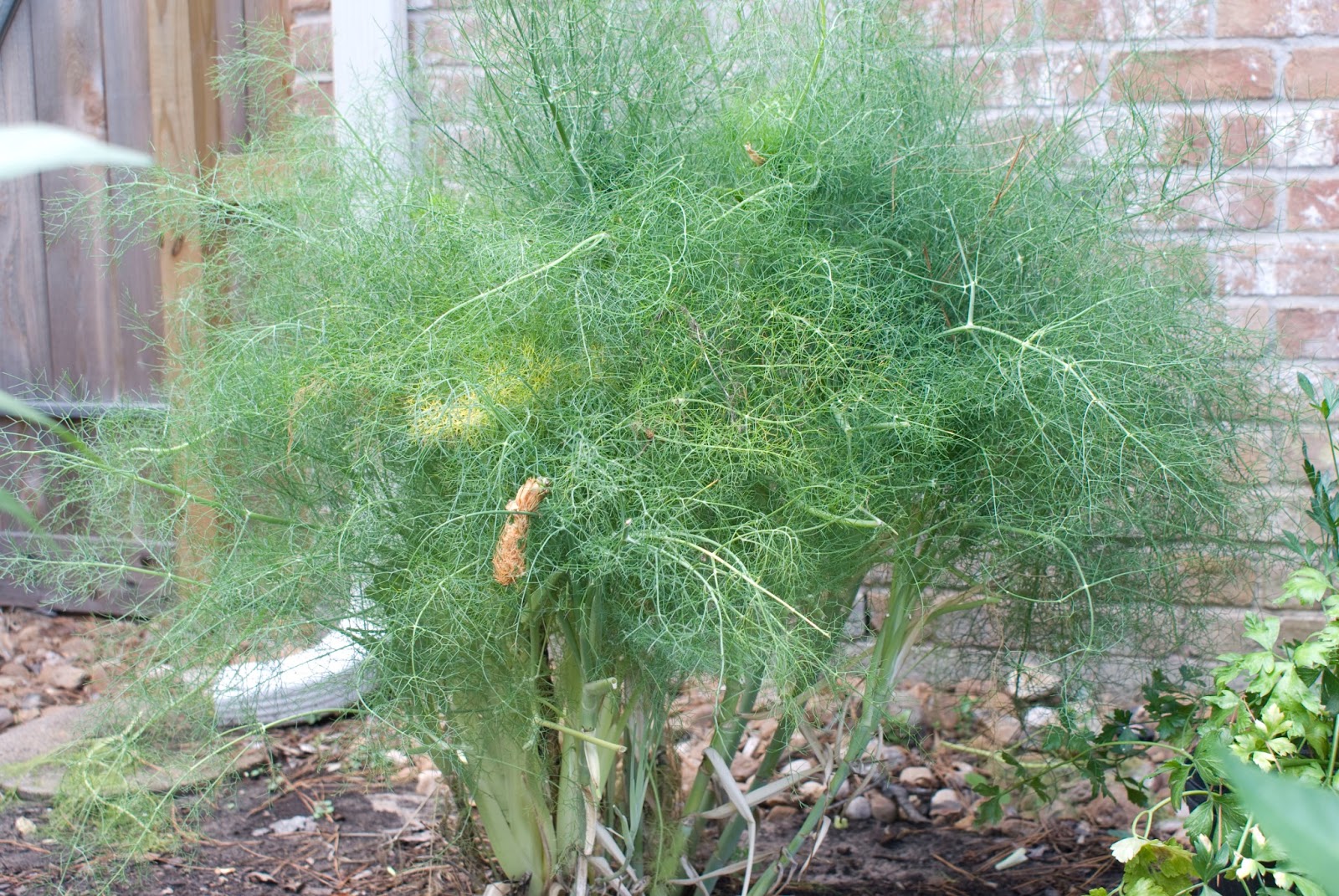
human, but wonderful for the herb. My garden, she does grow with dreamy scents. I am particularly interested in my Dill plant. It has grown to the size of a bush.
    When I look at my plant, I think of J.S. Bach. I imagine him a stoutly fellow, smiling as he wondered the streets, his puffy cheeks grinning at the ladies as they passed, his ear hearing a tune for the Sunday service. I don’t know why, but I imagine him as fuzzy.
     My Dill plant has long stems and branching out from them are fuzzy arms of the herb, thousands and thousands of fuzzy arms. The extensions much like Bach’s family - his children, his music.
     I don’t have to tell you Bach’s history, as I am sure you know it well, but I feel I have much to tell you about Dill and share with you a simple recipe for a tuna fish sandwich. I know, such a common folk thing, but oh so wonderful when made correctly.
     First to Dill – It is known as Anethum graveloens, part of the carrot family. This fact surprised me, but if you think of the ends of a carrot, you might could see a resemblance. So many times the herb gets lumped with Anise or Fennel, (sometimes called false anise or bastard fennel) but on my tongue I taste a whole different flavor.
     I go back to Bach again, and the Partita in A minor for flute. The piece should seem simple, yet the notes on the page are enough to scare any beginning flutist into thinking Bach was a masochist. There are those who say, the piece is just another extension of his Sonatas, a solo part mixed with his love of notes. But yet, this piece does not roll off my fingers like the Sonatas. It has a different coloring.
Yes I know dear friend, I can’t seem to keep my head on one subject, but don’t you see this is how an herb works, a piece of music works – we never stay in one place when using them.
     There is an old wives tale if you hang a bunch of Dill over your door you will be protected against witches. I wonder if it works for door-to-door salesmen. And Dill is mentioned some 5,000 years ago in Egyptian writings. In Roman times it was a symbol of vitality and the oil mixed with potions was used to soothe colicky babies. This is part of where the name Dill comes from. In Old Norse the world dilla means ‘to lull’. (My sources if you wonder are from Reader’s Digest Magic and Medicine of Plants, A $1 purchase at a sale and Medicinal Herbs by Patricia Turcotte, a gift from my mother)
     As for the culinary uses we all know the herb in pickles, fish, and potato dishes. The Germans love it. In North Africa the seeds are used in preparation of meat and in the Soviet Union used in salmon and crayfish.
And you don’t need much, which is why my plant gets so big. I can’t use it fast enough!
     Now let’s talk tuna. People dislike tuna fish sandwiches because they are made with three things – bad tuna, lots of mayo and relish. What a sad state of affairs when we think this is a tuna sandwich!  Of course I know that is the simple easy way, but would you go about practicing the Partita the simple easy way or would you dig in and do it right? Of Course!

My tuna sandwich:
  • First start with the best tuna you can get. Canned or jarred is fine but get top quality.
  • A dollop of mayonnaise
  • 1-2 tsp of grain mustard or Dijon (never yellow)
  • A tablespoon of capers finally minced
  • A tablespoon of onion minced (I like red but white will do)
  • 1-2 tsp of either red wine vinegar or lemon juice
  • Dill – I add about ½ a tsp but sometimes more (chopped)
  • Salt and pepper
  • Really good bread. Sour dough baguettes are wonderful. But plain ol’ wheat works also.
  • Serve with Sea Salt and Vinegar chips and a dill pickle.

Voila!
I think Bach would approve and I can think there might have been a smear or two of juice on his manuscript as he enjoyed his lunch and worked away.
Please send my best to all those afar.
And I remain,


The Mad List Maker

09 October 2012

"Sweeter than roses" (or, Can we come to an agrément?)

Dear Colleague,

Today I wanted to discuss the humble sweet potato. Or is it the unpretentious yam? Tasty and versatile, regardless of which plant, but the task of discussing this food item became formidable when I realized that, like trills, mordents, and flattements, sweet potatoes and yams are completely different plants. How different? Well, to begin, they are not even distantly related.  Yams are from the dioscoreaceae family, and sweet potatoes are from the convolvulacea family. Read the details here. Who knew? Well, at one level we all knew there was at least a small difference, based on the appearance. And we're all in agreement on their tastiness and the health and nutritional benefits from eating them.


In order to eat them, they need to be cooked (although I have given raw, chopped yams to my dogs, as part of their whole and raw food diet; I usually give them cooked and diced along with their raw meat, but that's another discussion for another time). The first time I ever cooked a sweet potato/yam, was when my wife and I were dating. Astounding, I know, that until that time I had never cooked a sweet potato/yam thing in my life. So I asked her, and I don't remember what she said, but it involved a slight scoring/poking holes with  a fork, the oven at a particular temperature, and put them on a baking sheet for a prescribed amount of time.

When I recently decided to cook a couple of YAMS as ingredients for my wife's special creation of black bean and sweet potato enchiladas (or, the non-vegan option of adding goat cheese crumbles to the mix), I couldn't remember either the temperature or time so I went to our formidable, no enviable, collection of cookbooks. I consulted Mark Bittman's invaluable How to Cook Everything, the Moskowitz & Romero  notable work Veganomicon, the venerable Laurel's Kitchen, and the classic Joy of Cooking. How could I go wrong following the instructions of these landmark works? After reading them, the question became: How could I go right? They were all different! They were all different on temperature, time, cooking vessel, and preparation. OK, so do these over-hyped, under-done, half-baked cookbooks actually know anything? Oh, wait. Right. The reason they are invaluable, notable, venerable, and classic is because they actually DO know something. That's why we bought them, use them all the time, and each book bears the mark of a wanna-be chef's kitchen (they are all soiled with food, sauces, water stains, and who knows what else).

OK, now what? This all seemed familiar, not just in a déjà vu kind of way but in a ripple-in-the-space-time- continuum kind of way. Continuum, basso continuo. Of course. I needed to look at this through an historical performance practice lens.But what types of treatises was I looking at? Vocal? Continuo? Instrument-specific tutors? It didn't matter. All the books were telling me what they needed to, and my task was to collect the information, mentally collate it into some order, or categorize different parts of it, and then ignore what the authorities said and make my own interpretation, based on historical models, of course. I was interpreting an event in much the same way as I interpret a piece of music as I prepare for a concert. And the same things that go into concert prep are what goes into food prep. Over time cooks and flute players acquire a base of knowledge through experience that allow them to make decisions in real time ("on the fly," in the vernacular) during their respective performance processes.

I don't remember exactly what I did with the yams (or were they sweet potatoes?), but the end result was just what I needed. And I'll probably do it differently the next time, just as each time I perform the Siciliano of BWV 1035, or the opening of TWV 40:2. It will be a brand new performance, reminiscent of the earlier versions, yet unique. Kind of like the similarities and differences between yams and sweet potatoes.

04 September 2011

Grass Fed (or, the Fundamental Bass)

Dear Colleague,

I recently had an exceptionally fine day with my wife at the State Fair. The usual things that come to mind were there: amusement park rides, textile and food exhibits, an extensive lumberjack competition, an exceptional plant exhibit (perennials and annuals), a formidable food gauntlet with everything from very good (crepes, Carolina bbq), to horrifying (corn dogs, and a place offering "mile-high fries"), livestock shows, a couple of horse competitions, and exhibits by the 4H and FFA.

Observing the young people involved in the FFA livestock exhibit brought home for me again the similarities between food and music.  Surely you are thinking "of course the FFA and the Brandenburg concertos have many things in common." Or not. But, from my way of thinking, with which you are familiar, the fundamental elements involved here will not come as a surprise. It was a heart warming experience to see a group of young people so dedicated to something, with a sense of purpose, The discipline involved in caring for the animals from birth to whatever their final destination may be. A daily practice is involved, to be sure, in caring for the animals.

You ask, "I see how this dedication, routine, and respect for something is similar to music, but how does this relate to food?"

It is not the dedicated young people by themselves that provide the parallel. It is the interaction with the animals, some of which become food. Being part of this process gives one the opportunity to watch something grow, mature, and finally be part of something else. The animals that mutate into the food state go through another process and become part of something else, and at this point the young people are no longer involved. But they provided a unity in the food chain, similar to what Jean Philippe Rameau called in  his Treatise on Harmony, the fundamental bass in music. Or as demonstrated in Francesco Gasparini's L'Armonico Pratico al Cimbalo, the building of harmony from the ground up.

An awareness of the source of our food, be it plant or animal, should be more a part of our daily eating. Ann Vileisis discusses this in captivating detail in her book Kitchen Literacy. And our daily practice of music should include an awareness of the composition process. Very few of us these days are performer-composers such as J. S. Bach, Giuseppe Tartini, or François Couperin, and fewer still of us have made the effort to study rhetoric and oration and their relevance in composition and performance. An awareness of the sources and processes is our foundation for food and music and are essential to a good understanding of them, and should be considered in our preparation of both.

When people speak of grassroots movements, they perhaps should think of Rameau or Gasparini, and build their structure from the bottom up, grass fed.

I remain,

y.m.h.&o.s.,

Quantzalcoatl

03 July 2011

Tacos de Pescado con Agréments (or, ¿Did Couperin Visit the New World?)

Dear Colleague,

Tonight we had the simple fish taco. The finished product reminds me a of an air de cour, ornamented following Mersenne's guidelines in Harmonie universelle (Paris, 1636-7). On the surface a taco is just a taco, and an air is just an air. Neither appears exceptionally complex but that is why both "compositions" provide such a satisfying result (when prepared properly).

The air de cour poetry will never be confused with Petrarch, Guarini, or Machaut. And shredded cabbage will never be anything but peasant food. But when you combine the air de cour poetry with the melodic line and seventeenth-century French harmonic vocabulary, the elements of performance practice, and my favorite performance element, rhetoric, each air can then touch your soul. The touch can resemble anything from a delicate caress of your cheek, to the searing pain of a boning knife jabbed right between your ribs en route to your heart.

The taco? The required elements:
  • A homemade corn tortilla (I use a tortilla press, but, of course, a good quality, locally made tortilla purchased at a grocery store that sells primarily organic food will work just as well), 
  • pan-roasted wild-caught true cod, 
  • organic, refried black beans, 
  • green, Napa, or Savoy cabbage (or, if you want some good color contrast, add some purple cabbage as well), 
  • diced tomatoes, 
  • scallions, 
  • chopped cilantro, 
  • lime wedges 
 And the essential elements, the rhetoric of the taco, so to say. My choices here reflect my personal taste and the philosophy of "think globally, buy locally."
  • Lime-and-Chimayo-chile infused fat-free sour cream (one could use any chile powder from ancho, guajillo, to cayenne),
  • either Rogue Creamery's Raw Milk Cheddar (Central Point, OR), or my favorite, Beecher's Flagship cheddar (Seattle, WA)
  • queso cotija.
One could use just plain sour cream, or none at all, or any cheese, and have an ordinary eating experience. One could also just sing the words of the air just as they are, with no rhetorical inflections, no flexibility in the rhythms, and with nothing but the plain notes. In each case, what will you have? A list of ingredients that may or may not satisfy you.

As with most of the music we refer to as Baroque, the notes on the page are merely mnemonic devices; 50% of the music is the responsibility of the performer, who has to function in the manner of a composer-performer from the 17th and 18th centuries.

And as with any food we prepare for ourselves or others, the raw ingredients are just a point of departure. The beauty of the finished product comes from the way the ingredients are combined, supervised by the personal touch of the composer-performer. A chef is a chef; chef de cuisine or chef d'orchestre.

I remain,

ymh&os,

Quantzalcoatl